
«Μιαν τασσινόπιττα, τζιαι έναν κυπριακό καφέ…σκέττο παρακαλώ…»/”A sweet tahini pastry and a Cypriot coffee (no sugar please)”, was the phrase I began most mornings during my sabbatical last Autumn in Nicosia – my daily visit to my local Zorbas (the most popular of Cypriot bakery chains) was both hurting my waistline and current account, but who could resist the island’s culinary prowess, especially since bikini season was [almost] over.
Τhe only city on the island that is situated firmly inland, the Cypriot capital is where half of my family calls home. A city of contrasts (and the only divided capital in the world*), it marries modern architectural motifs with historic neighbourhoods, and its energy is concurrently European, West Asian and Mediterranean; it is this dichotomy that makes Nicosia a hodophile’s delight.
Sites
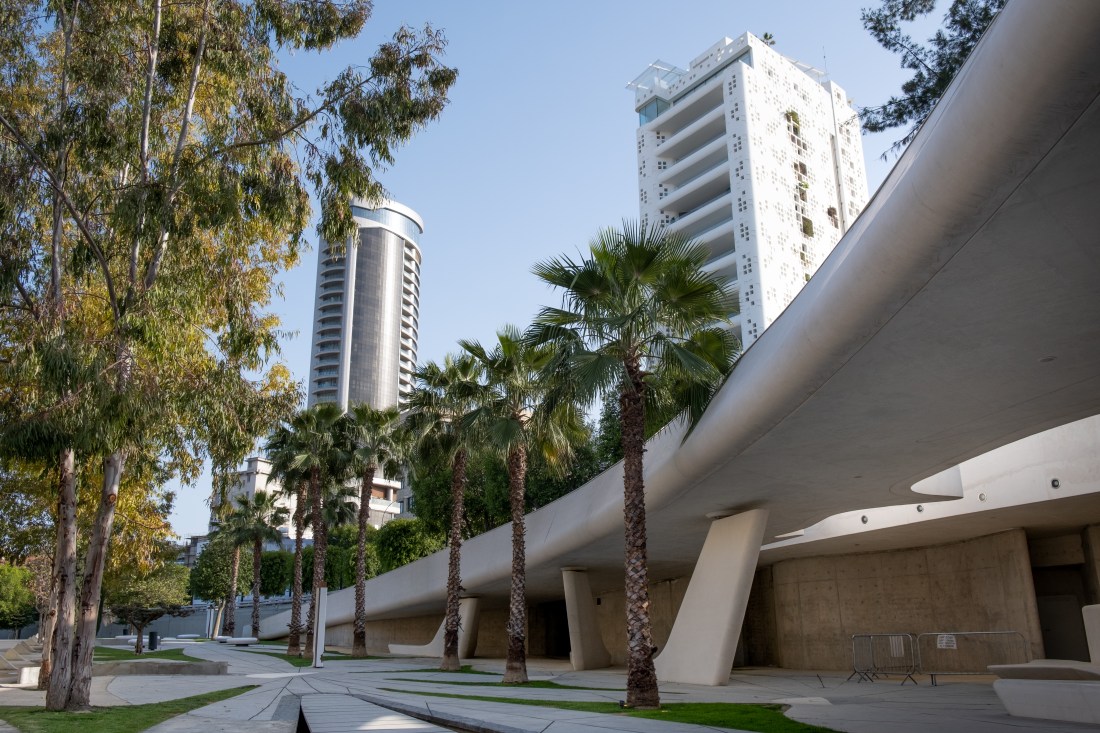
When visiting Nicosia, the recently re-opened Liberty Square/Πλατεία Ελευθερίας, the capital’s main piazza, should be the start of any tour. Completely re-designed by internationally-renowned Zaha Hadid Architects, the square now boasts giant pristinely-white undulating structures, strategically interspersed with Cypress trees (yes, the double entendre isn’t lost on me…), a multitude of fountains and pools of water. The square provides a much needed space for cool respite, especially when temperatures soar to over 40°C in the summer.
Adjacent to the square are the city’s Venetian walls, separating the Old Town from the new. The Venetians ruled the island for a century, and their impressive fortifications stand largely unchanged, their circular shape comprising almost a dozen bastions; an aerial view of the walls appear as though they form an 11-pointed star, whose shape incidentally features in the emblem for the Nicosian municipality.
Just inside the walls is Laiki Gitonia, an area with a charmingly humble atmosphere, bustling with small shops; you will also find Ledras Street, the main shopping road of the city which is split between the two communities, and is host to one of the main Green Line checkpoints on the island. Before reaching the checkpoint, take a right onto Onasagorou Street and then onto Phaneromeni Square; these roads feature a number of quaint coffee houses and tavernas, all clustered around the church dedicated to the Virgin Mary.
My top tip for Nicosia walks, however, is venturing to the area of Taht-el-Kale. A 10-minute walk from Ledras, it comprises countless mansions built at the end of the 19th century, and a number of very reputable restaurants, bars and cafes (see below). A key place to visit is Ermou Street, home to artisanal workshops and boutiques: pottery schools, interior design shops, art galleries and homegrown fashion designers all call this area home. It is truly a joy to stroll around and admire the buildings made of Cypriot sandstone, with the area being very near other key sites like Famagusta Gate (part of the Venetian Walls), the Statue to Freedom, the Byzantine aqueduct, the lavish Hadjigeorgakis Kornesios mansion (home to an Ottoman dragoman) and the Archbishop’s Palace, to name a few.
If you’d like to escape the heat, museums and art galleries are a quick win. The Leventis family, one of the wealthiest in Cyprus, are great patrons of the arts and have over the years opened both the Leventis Municipal Museum of Nicosia, housing Cypriot artefacts from ancient times (3000 BCE) through to the modern era; and more recently, the A.G. Leventis Gallery, containing 19th and 20th century Cypriot and European works of art (including but not limited to Renoir, Monet, Chagall, Kanthos and Engonopoulos). It is noteworthy that the latter’s building is in the shape of Π, the first letter in the Greek word for gallery (Πινακοθήκη).
Food
Call it bias, but when many look to the gastronomic delights of fashionable Stasikratous Street (known for its international fashion brands) or even the Old Town (think Ledras/Onasagorou), I like to frequent the degustation quadrilateral which includes Pindarou, Stasandrou and Stasinou Streets. This is the true food and beverage powerhouse of the city, found in “new” Nicosia (i.e. just south of the Venetian Walls).
If you’re to retain anything from the upcoming long list of restaurant tips, please keep Bemba in mind – it is the talk of the capital, set in a beautiful open-spaced terrace adorned with fauna and fairy lights, offering an edgy take on classic Cypriot and Greek dishes. Equally exquisite is nearby Ethimo, which also offers a rivallingly-good modern Greek menu. A block away is SCALE, a contemporary restaurant with an even more modern spin on local cuisine; the flavours are wonderful, as is the hotel (MAP) that houses it. Nearby COOKSHOP is also a favourite, with a multitude of European cuisine-inspired dishes. And if Cypriot delicacies become a bit too repetitive, Bottega Amaro is one of the more popular Italian restaurants in town.
For something more traditional in the Old Town, I always opt for Tsipouraki Mezedaki, a quaint taverna set amongst old sandstone buildings, with unrivalled flavours, brilliant service and a sweet sense of nostalgia. Not far are the more up-market Aigaion and Vintage, both transport you to modern day Athens, where interior (and exterior) design meet culinary excellence: the former focusing more on Hellenic flavours, the latter on pan-European.
However, if you’re looking for something cheap yet cheerful, then takeaway kebabs and sheftalia (meatballs) from To Souvlaki tis Nikis are a firm favourite of mine. Another staple option is Avo on Onasagorou Street, an Armenian-Cypriot establishment whose wood oven produces the most delicious lahmajoun and halloumi pies.
Coffee
In the Mediterranean, coffee (whether it’s a frappé or even the dead-awakening Cypriot coffee) is a non-negotiable daily ritual. The capital, therefore, is home to many coffee shops, ranging from the traditional (where a backgammon game wouldn’t go amiss), to extremely well-known global coffee chains (which all seem to be housed in exquisite spaces) to popular local brunch spots (DOT or Silver Pot for example) which are usually littered with “Cypsters” (a term I’ve coined for Cypriot hipsters…).
My go-to local spot is A kχofee project (don’t worry, I don’t know how to pronounce this either…) – despite it’s unpronouncable name, this café has an idyllic tranquility about it; decorated with plants and a simplistic design, it serves the best coffees and juices which will perk you up on any day of the week. A more boujie option would be Istorja, part of a well-known hospitality group on the island, its interior and exterior are beyond aesthetically pleasing; boasting a wonderful homewear collection on the ground and first floors, this store also has impressive coffee options, like its superb freddo cappuccino, as well as delectable pastries. I am also a regular at Kollaborative, a chilled and cheerful establishment, serving coffee and snacks in the day, and great cocktails at night.
For something a bit different, I would wholeheartedly suggest Erma. What is essentially a converted colonial mansion which operates as a bookshop, it’s beautiful Levantine courtyard found at the back of the property serves coffee and a myriad of alcoholic libations, the perfect way to enjoy an early evening aperitif or two.
Bars and Going Out
In the Old Town, one is completely spoilt for choice when it comes to beautiful bars that are situated in old sandstone mansions: Korniza Baroque, Patio and Domus Lounge are all superb options where the aesthetics of Cypriot architecture converge seamlessly with relaxing ambiences for late-night drinks.
In “new” Nicosia, my favourite bar, situated in the aforementioned “quadrilateral”, is Lola’s – with its delightful vibe and close proximity to many great dinner spots, it serves fantastic cocktails, and is my staple place for pre-drinking. Additionally, just off Makariou Avenue is recently renovated Bálza, the chicest of Nicosia’s rooftop bars, whose wall projections and horticultural decor add a touch of glamour to any evening spent in the Cypriot capital.
Nicosia isn’t a big clubbing city like other places on the island – e.g. Ayia Napa (say no more), or even “bouji” Limassol – however it does have unrivalled bars in many of its towns, both within the Venetian walls and in the central area around Makariou Avenue. Apart from the obvious options (WSTD, Teez and State), I would recommend Ithaki, an LGBTQIA-friendly club; its welcoming open-air terrace plays dance anthems which always guarantee you an unforgettable night out.
*This post purely focuses on the section of the city situated in the Republic of Cyprus. However, there are of course many monuments to see in the northern part of Nicosia, including the Ottoman inn of Büyük Han and St Sophia Cathedral/Selimiye Mosque.


